Wednesday, October 28, 2015

My Guest: Jaye Rothman

My Guest this week shares a couple of things with me: First she's a lover of hard-core Spy thrillers, having cut her teeth on Ian Fleming just like yours truly, and second, she uses strong female protagonists in her novels. Ladies and Gentlemen...


Jaye Rothman

Love and Cold Wars


If there is a book that you want to read, but it hasn't been written yet, you must be the one to write it. ~ Toni Morrison.

I grew up in a sleepy little town outside London, England during the Cold War. Perhaps because of that, I have always been fascinated by life behind the Iron Curtain.

When I was just a teenager, I watched my first James Bond movie. It was one of the very early ones – I can’t remember which one, now – and I vividly remember being absolutely mesmerised by the action, the intrigue, and the exotic locations. The next day I rushed to the library and over the next few weeks I devoured all of Ian Fleming’s books. Shortly after that, I discovered Len Deighton and John Le CarrĂ© – and so began my lifelong love affair with espionage novels and movies.

In particular, I think Deighton’s three trilogies, featuring Bernard Samson as the disillusioned MI6 spy, perfectly capture the era and the paranoia of the Cold War during the 1980s. They are still among my favourite books.

One thing that always bothered me as a female reader, though, was that most of the protagonists in spy thrillers were men. I desperately wanted to read about a female James Bond–type character, but there was nothing.

In 1989 the Berlin Wall came down and the Cold War officially ended – but my fascination with it did not. Nor did my quest for stories about female Cold War protagonists.

Amazon Link
During the 1990s, Stella Remington, who was then Director General of MI5, wrote a series of books featuring Liz Carlyle, who (unsurprisingly) worked for MI5. I devoured them, hoping against hope… But no. Close, but not quite: the books were set in the 1990s. “Too little, too late,” I thought.

Fast forward again to 2012 when, like many people in our middle years, I was becoming increasingly disillusioned with my job. One evening after I’d had a particularly horrendous day at work, my partner turned to me and said, “You spend hours reading thrillers. Why don’t you write one?”


Why indeed? I wondered, and the die was cast.

But where to start?

When I was at university I had written papers, of course, but I had never written anything fictional. So I Googled “writing classes in New Zealand,” and came across a correspondence writing course with the intriguing title “How to write a thriller in 10 weeks.”

I enrolled, and four days later a package arrived. Eagerly, I ripped it open, read through the contents and began my first assignment.

First, of course, I needed a protagonist. That part wasn’t actually all that difficult: during my years of searching in vain for a female Cold War spy/protagonist in other people’s books, I had been constructing “what if” scenarios in my head, imagining a female character I would have wanted to read about. She even had a name: MI6 agent Nikki Sinclair, the heroine I write about now. But writing a believable character proved to be more of a challenge: I had to give her a past, a life story, lay out the reasons for why she behaves the way she behaves and does the things she does.

Next, I needed a plot.

Amazon Link
Again, I had one handy: during the 1980s I had had a hair-raising adventure in Kinshasa – for real! – and I’d always suspected it would make a great story line for an espionage thriller: I was flying to Johannesburg and we were scheduled for a two-hour stopover in Kinshasa, in what is now the Democratic Republic of the Congo but was then known as Zaire. On landing, we were told that the plane had developed mechanical problems and, as the parts had to be flown from Lisbon, it would take three days to fix.

All of us white passengers had to surrender our passports, and we were then bundled into a clapped-out bus manned by armed soldiers and told we were being taken to a hotel outside the city.

I tried to remain calm as I stared out the windows at the streets and the people – not an easy task. We passed an army camp, and the soldiers barked at us not to take photographs or we would be arrested – believe me, photography was about the last thing on my mind!

Eventually we arrived at a run-down hotel in the middle of the rain forest. The soldiers jumped down first and ordered us all off the bus. Among other instructions, we were given explicit orders not to leave the hotel grounds. Someone asked to use the telephone, and we were told that all the communications had broken down and would be fixed in a few days – long after we were scheduled to depart again, of course.

We all settled in as best we could, and then descended en masse for dinner. The dining room at the hotel and the uneasy small talk we made among ourselves are what I remember most vividly about that first evening; the forced camaraderie and simultaneous anonymity of hotel dining rooms are a feature in many of my books.
And if you’ve read my book 'The Hell of Osirak (Betrayal)', my description of the route my characters take through the streets of Kinshasa is actually the route our bus took on that night in the 1980s.

Back to my assignment: to add to the visuals of the Kinshasa plot, I recalled reading in a newspaper about the shipment of yellowcake uranium from South Africa to Israel. Once again I started Googling information about it, and came across the back-story of Israel’s bombing of an Iraqi nuclear reactor called “Osirak” in 1981 during Operation Opera (a.k.a. Operation Babylon). Although there is not much verifiable information on the build-up to the actual bombing, it didn’t matter: I had found my story.

It took me about a year to write it, then to rewrite it and rewrite again – this is a fact of life for most authors. And like many of us who are just starting out, I worked full time during the days, and wrote at weekends, during the evenings, and in any and all down-time I had. Towards the end, I started to get restless, which is usually a good sign: I just wanted to finish the thing and get it published!

When I could see light at the end of the tunnel, I employed an editor to clean it up and a graphic designer to create a cover. When the text was finally ready, I had it formatted and then, heart in mouth, I self published it.

Amazon Link
Did I sell thousands of books? Of course not – few authors churn out a best-seller on the first try. But considering that I was a “newbie” who hadn’t had a clue about marketing, design, or the importance of a good book description, 'The Hell of Osirak' actually had good reviews and some very positive feedback.

By now I had caught the writing bug in earnest. During my research for Osirak, I had stumbled across the so-called “Umbrella Murder” of Bulgarian dissident writer Georgi Markov in London in 1978. The details were gruesome, of course, but also fiendishly clever, and I had another one of those “what if…” moments: what if my heroine Nikki Sinclair were to be tasked with investigating a similar murder? What if there was not one victim but two – say, two Soviet defectors? And what if they were working away in a secret facility right under the noses of their British hosts?

And thus the plot for 'Murder by Umbrella' was hatched.

I had actually intended for it to be a stand-alone book, but as I wrote it, more ideas popped into my head for yet another book (did I mention that writing bug??), so I decided rather ambitiously to write a quartet.

As part of my own career development, in July of this year I attended Thrillerfest in New York City – it was my first trip abroad in ages, and although (thankfully!) there were no gun-toting soldiers on rattle-trap buses or isolated hotels, I did come away with some excellent ideas, and some solid advice: Write, write, and write some more. Write a quality book that has a good story and is edited well, and then repeat and repeat again.

Easier said than done, of course, but I am most definitely up to the task. Stay tuned!


Bio:

London-born author Jaye Rothman is a seasoned explorer, having travelled all over Europe, as well as to the United States, Australia, and Africa. She has also lived on a kibbutz in Israel.

A long-time lover of Cold War espionage stories, Jaye brings her own brand of unique wit and sense of romance to other fans of this genre. Her first book, The Hell of Osirak, features British agent Nikki Sinclair, a tough and uncompromising hero for all lovers of exciting spy drama.

Jaye currently lives in Auckland, NZ with her dog Izzy, who is a large and loyal English bull terrier-lab-pointer mix, whose soft white fur is adorned with coffee-coloured splashes.

When Jaye is not penning fast-paced, action-packed Spy Thrillers she can be found here:

Blog:          goo.gl/rWXlND 
Website:    goo.gl/Yv82s9  
                  (Many of her boards relate to her books.)


Thank you, Jaye. Reading the above was like deja vĂ¹ all over again (to quote Yogi Berra). My own trajectory is so similar to yours in so many respects, it was spooky.  I strongly recommend 'Murder by Umbrella' to lovers of great spy fiction - I read it last year and it was outstanding!

Wednesday, October 14, 2015

My Guest: Stefania Mattana

My Guest this week brings with her a host of other characters. Yes, they are the ones we may often forget, yet without whose presence our protagonists and antagonists would not be who they are. Ladies and Gentlemen...


Stefania Mattana

Secondary characters in fiction: 
why you can't neglect them


Every hero has a sidekick supporter. Here are some vital reasons the secondary characters development in fiction is so vital.
Amazon Link
There's no Batman without Robin, no Harry without Ron & Hermione, no Sherlock without Watson. In fiction, there are endless examples of minor characters who are not less important than the main ones. Let's see in depth why readers love them (sometimes more than the heroes!) and why plots can't exist without them. 

Sometimes Secondary characters are the core of the stories because they provide conflict.

Yes, the main character is the hero and/or the recurrent one in a book series - but what about the dark side of the plot? In mysteries, for example, there are killers to catch, and even if sometimes we don't know their identity, killers are ipso facto secondary characters, and everything turns around them.
Background characters can be also not likeable, on the other hand.
Amazon Link
Readers need someone to love, but also someone to reverse their hate to. Secondary characters fulfill that need. There are rare occasions where the main character is unlikable, and most of the times he's flanked by a positive character anyway - think of Darth Vader and Luke Skywalker, for example.
Secondary characters protect and back up the main characters.
Think of the most iconic couples or trios in the fiction literature: minor characters are often friends of the main hero and help him out in time of needs - or the other way around. In my mysteryand detective book series, the main character, Chase Williams, is a former Scotland Yard detective relocated in Italy, who helps his friend Inspector Angelo Alunni solve some murder cases happening in town. No matter how hard the main character(s) tries, nothing can be done without the support of the secondary
Amazon Link
characters, though. Unless you are not reading The Odyssey.
Secondary characters provide tridimensionality.
My mystery stories would lose their genuine nature if I haven't develop my main character's neighbourhood, which is populated by typical Italian inhabitants and gives the reader a truly experience of Italy. The world around Chase Williams takes life not only with descriptions and colours, but also thanks to the background characters who talk and interact with him.


The only danger here is to fall into stereotypes, but that's easily fixable by spending a bit of time defining the minor characters in details - doesn't matter if you include all their specifications in your stories; once you have sketched the characters, you know what to say about them and what to elude.

Consequently, secondary characters bring new plot and sub-plots on.
Each of them has a story that can be told, and can also cross the main plot.
New points of view are pulled by secondary characters.
My readers will never forget the moment when Chase and Inspector Alunni had an
Amazon Link
argument so bad that it brought even worse consequences - but at the same time that helped solve a murder case. Minor and background characters can show different perspectives of the same topics or situations to both readers and main characters - giving to both of them room for considerations and changes.
Animals can also work out very well as secondary characters.
Who said humans have to be the sidekicks? Chase solved some unusual mysteries thanks to his neighborhood dog, Luciano. If Luciano wasn't there, my readers would have less stories to enjoy! (not to mention the fact that Chase doesn't have Luciano's smell skill!)
A quick note for the writers to conclude my examination.
It's the author's responsibility to give secondary characters enough space on any plot. Readers needs minor characters as much as the main hero. Many readers can relate much more with secondary characters and find in them relief if the plot is getting too stressing or some sparks of curiosity or interest if they don't fancy the main plot (or the main character) very much.
In two sentences:
Sometimes, secondary characters hold up the whole novel and go outside the story. That's how spin-offs are born, but that's another story for another blog post.


Bio:

Stefania Mattana writes mystery and detective novels because she's a snooper. She and her main character Chase Williams, a former MET officer, have swapped locations, so she now lives in London while he enjoys the Italian life. 

Stef is an avid reader and a keen runner. Ever present on the internet, has written many nonfiction and fiction books, but she's having a blast with the Chase Williams Murder Mystery Book Series. When she's not writing or practising the dark art of SEO, she stalks dogs. 

Stef's relevant websites/social media hubs:

Websites:
Chase Williams: 
http://chasetwilliams.com
Stefania Mattana: 
http://eraniapinnera.com
Mailing List (for news and exclusive content): http://eepurl.com/Atn-5


Thanks you, Stef, for your comprehensive review of the importance of our support characters which I'm sure will help readers and writers alike to appreciate their understated role. Best wishes for your novels.

Wednesday, September 30, 2015

My Guest: Claire Smith

My Guest this week tackles an interesting, and very personal subject; one from which many newer writers may draw solace and guidance. Ladies and Gentlemen...


Claire Smith


Fiction – The Secret is in the Name


When starting out as a writer, or ‘aspiring writer’ as some people insist we are called until we crack the bestseller lists, we are bombarded by advice from all quarters. Most, no doubt, given with the best of intentions but much of it is also useless and in some cases off-putting. As intelligent as we may be it is sometimes hard to sieve out the good guidance from the downright impractical.

Anybody who has ever mentioned a desire to write has no doubt heard the widely distributed instruction of “Write about what you know”. But in all honesty how helpful, or indeed accurate, is this directive?


Amazon Link
Surely this would severely limit our creativity? Does our imagination and ingenuity not have a role to play? If we can only write, and hope to be considered worthy, about things we have actually experienced then, even those with the most interesting of lives will only have enough potential material for perhaps one or two novels. Those with mundane and ordinary lives cannot even hope to be fiction writers if this adage is to be considered even vaguely true and should, therefore, hang up their dreams of becoming a published author.

The fantasy and Sci-Fi writers among us would be in dire straits and restricted merely to those who can claim to have been abducted by aliens. That’s not to mention historical fiction for which we would need a time machine and paranormal fiction for which who knows what we would need. The list of problems this ‘good advice’ creates is endless.

All in all this advice cannot seriously be considered advice at all, merely a phrase trotted out by people who actually have not given the problem any thought at all and simply, in my opinion, serves to put would be writers off before they even start. I sincerely hope there are many more people like me out there who looked at this particular piece of helpfulness and viewed it with the contempt and mistrust it deserves.

Amazon Link
For me surely the advice should be “Use what you know to its best advantage and then research the rest with fervent dedication to detail.”

That’s the way I saw it when I wrote my first novel ‘NO MORE BUTTERFLIES’. Some of the more harrowing parts and the darkest of the emotions were certainly drawn from my own experience as a child and teenager but even they were embellished to fit the plot I had created. Having been in some of the situations I was writing about certainly helped me with communicating the emotion these scenes generate, and, writing these scenes definitely helped me to understand my own reactions to events much better, an advantage I had not really considered when I started adding my own traumas to the plotline. That said, anyone with access to the internet and a basic understanding of human psychology could find more than sufficient information to create these scenes without having been there. 

When it came to my second novel, ‘A STORM RISING’, again, I used the lasting effects traumas have had on my psychological health as a basis for my heroine’s character, and some of the bullying, both domestic and professional, was from experience. But these only form part of the equation, for the rest I trawled the internet researching every last detail.

Amazon Link
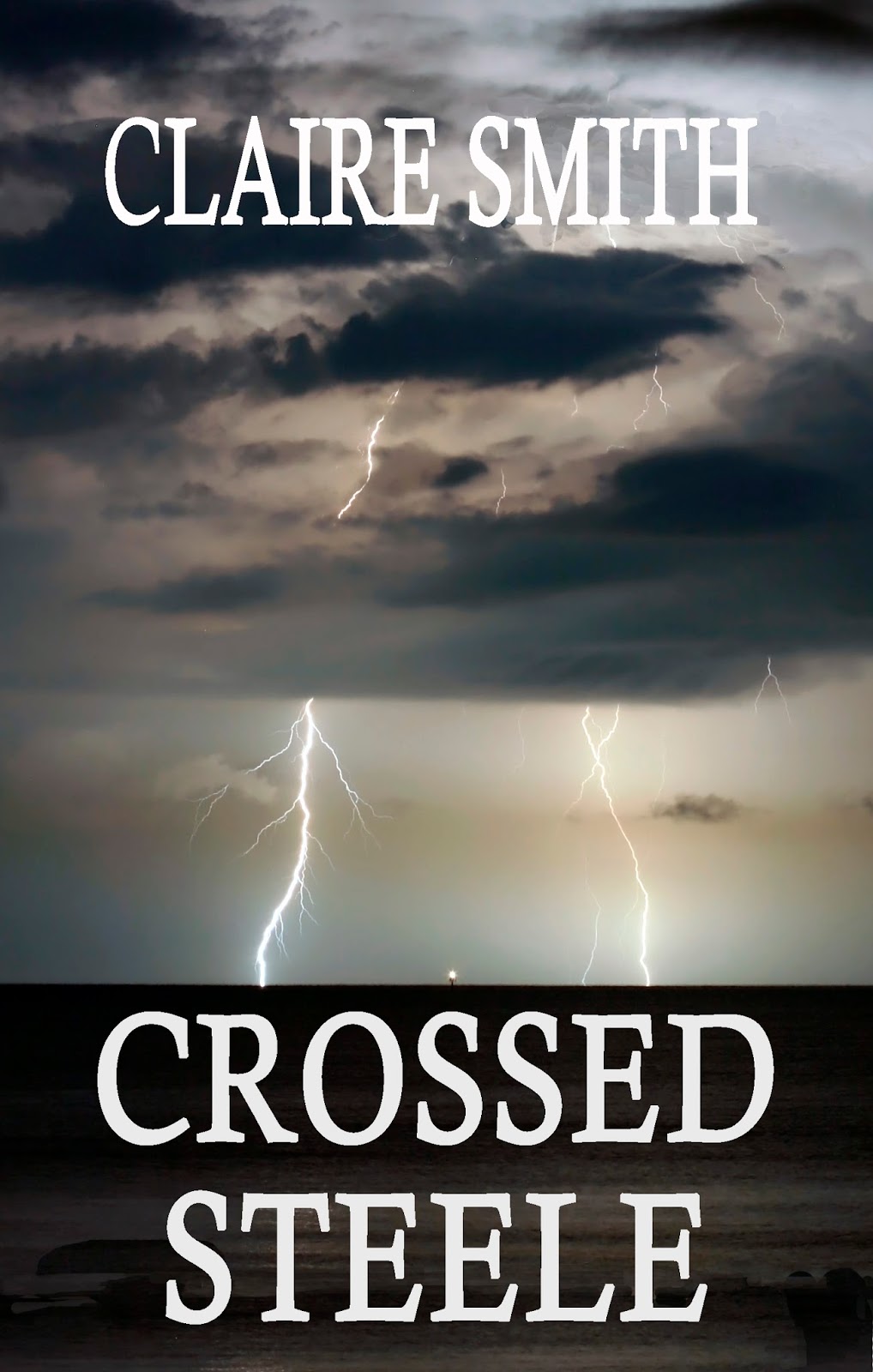
My third novel, second in the Storm series, ‘CROSSED STEELE’, uses even less personal experience as I've pretty much used them up in the first two. Does this make it a lesser creation, I don’t think so. Although my next novel, as yet unfinished, will contain certain aspects of the after effects of PTSD and how my heroine learns to live with such problems, which I can glean from my own life, the rest of the novel will be entirely from research, and so the series will hopefully go on. I would hate to think I could not write any more either in this series or stand-alone novels because I have run out of horrible experiences to write about.

At the end of the day we are fiction writers – the secret is in the name. We make stuff up. That’s the whole point and to make it plausible it does not have to have happened to the author, but it has to have been thoroughly researched by said author. Anyone writing without doing their research is as obvious as the sun in the sky and will, without exception, create a novel which is difficult to read and even harder to love.

Plausibility should be the buzz word we all strive to achieve, not honesty, not ‘based on a true story’ fiction, less real life and more true to life is, and should always be, our aim.

So my advice, for what it’s worth, to all writers or anyone considering becoming a writer is simply this - Write about anything which interests you enough to put pen to paper and research anything and everything you don’t already know.

A great novel comes from hard work, dedication and an ability to string a sentence or two together correctly, not from the depth of a person’s lifetime experience.

Never confuse the two.


BIO

Claire Smith lives in Sale, South Manchester, England with a husband, two teenaged boys and a year old springer spaniel/border collie cross called Mac.

Since childhood she loved to read and soon graduated from ‘The Famous Five’, through ‘Swallows and Amazons’ to Jacqueline Suzanne and Jackie Collins in her teens.  In her twenties she discovered such writers as Tom Clancy, Frederick Forsyth, Clive Cussler, Wilbur Smith and Robert Ludlum to name but a few.  However, it was not one of these greats who inspired Claire to write.  It was a series of dreadful books by several someones she can't remember which prompted her to make real the notion "I could do better than this..."

So 'NO MORE BUTTERFLIES' began.  It took several years to write, with children, home life, husband and job all getting in the way at some point or other but eventually it was finished.

Published for the first time on Kindle in May 2013 the reviews so far have been very encouraging.  So much so in fact that Claire has written her second and third books.  'A STORM RISING', the first in the Abigail Storm Series, and 'CROSSED STEELE', the second in the same series, are also available on Kindle and paperback.  The next in this series is currently WIP.

When Claire isn't pounding on the keyboard, producing heart-thumping thrillers, she can be found here:


Thank you, Claire, for your magnificent insights and helpful advice from which many writers, both new and old, will benefit. Looking forward to your next book.

Wednesday, September 16, 2015

My Guest: Seumas Gallacher

This week I'm very please to have a return Guest on the blog; the inimitable Scots Scribe hisself. He's joined the ranks of those of us who have written... Ay, but I'll have the man tell you about it hisself. Lasses and Laddies...


Seumas Gallacher

…writing a series is a serious business…


…one of the many things I’ve been learning over the last several years of immersion in this writing gig is that constant surprises are the order of 
Amazon Link

the day…I finished scribbling the first Jack Calder crime thriller, THE VIOLIN MAN’S LEGACY in mid-2008 and thought I was done… the reality took a while to sink in… I was only just beginning… the simplicity of continuing with the same generic crime/action theme flowed into VENGEANCE WEARS BLACK… plot lines screamed at me daily… the characters had plenty of things left they wanted to get up to… hence the third offering, SAVAGE PAYBACK , and lately, the fourth, KILLER CITY, tumbled from the laptop… the fifth novel, currently Work-In-Progress, DEADLY IMPASSE, is bubbling away nicely… it had never occurred to me at the beginning that a series would evolve, but when the third book was done, it was an unavoidable truth… Jack Calder and the rest of the players had dug in their collective heels… they were here to stay… the take-up from my readership has been enormously gratifying, but I’ve discovered also, that I 
Amazon Link
feel it comes with certain obligations… Lawd knows, I LUV the stories myself, else I wouldn’t be doing them, but I dread falling into the trap of ‘formula’ manuscripts and try to guard against it… the disease that all too often afflicts novelists I have read in the past… far be it from me to throw literary stones at some of the major recognised names in the industry, but there are far too many occasions when it’s apparent a successful author has simply produced ‘more of the same’ after a while… the ‘zip’ goes out of the story-telling… the freshness disappears… so, how to guard against the ‘repetition-depletion syndrome’?... here’s a few ideas from this ol’ Jurassic…

…understand the difference between a ‘serial’ and a ‘series’…

Amazon Link
…a ‘serial’ is the same story with continuing chapters or sequences or books, and difficult to hold readers’ attention over a lengthy period… fresh nuances and new plot flows for the same story are limited… sustaining these becomes less and less feasible…

…a ‘series’ is a group or collection of independent stories, with something in common… a much easier quill-scraping road to take…

…therein lies the key to it all for me… and why superb Authors like Ian Rankin can produce such attention-holding books ad inforeverum… each book starts over… new twists… unique facets for the players to deal with… but, and the great ‘but’, is this… readers come to know, to recognise, and to like the qualities of the main characters who continue to populate the series… the learning curve for them has already been established… I try to ensure that my books tell a new reader enough about the main people, without flogging the detail to death… that way the new reader is enlightened, but regular followers of the series are not bored reading it again… tell it a slightly different way… allusion sometimes is more effective than labouring the fine points… most readers like to visualise things for themselves about yer characters…

Amazon Link
…character development continuity is important for loyal readers, and that need not conflict with bringing new readers into the game… in fact, if the on-going development of the characters is done well, the ‘newbies’ may go looking for the writer’s ‘back list’… crime fiction with danger and raw action should reflect real life to a degree… it becomes less and less credible if the characters constantly encounter life-threatening or injury-threatening situations without some casualties or even fatalities taking place… I’m not advocating the Game of Thrones approach where every player is at short odds of surviving to the next episode, but life is not always fair… sometimes as an Author you have to bite the bullet and let one or two of yer wee lovelies meet their Maker…

…overall continuity through the series for this writer lies in keeping true to the basic tenets that drove the very first book… the concept being that ultimately the good guys win over the bad guys… I make it clear as early as possible in each novel who are the true ‘nasties’ and why it’s a good idea to pursue the hell out of them… that will not change… developing sane reasons for my ‘people’ to be involved is important… I want the reader to join with me in discovering how the team gets there in the end… and it’s not always a ‘slam-dunk’… therefore, I’m obliged to keep my own writing wits about me in unravelling the narrative… and often surprise even myself in the denouements…

…and lastly, but by no means least… I have to enjoy re-reading the stuff I write… that way I attempt to keep true to my mantra… ‘I write for me… the kind of books that I would choose to read’… see yeez later… LUV YEEZ!...


BIO

SEUMAS GALLACHER escaped from the world of finance seven years ago, after a career spanning three continents and five decades.

As the self-professed 'oldest computer Jurassic on the planet’, his headlong immersion into the dizzy world of eBook publishing opened his eyes, mind, and pleasure to the joys of self-publishing. As a former businessman, he rapidly understood the concept of a writer's need to 'build the platform', and from a standing start began to develop a social networking outreach, which now tops 22,500 direct contacts.

His 'Jack Calder' crime thriller series, THE VIOLIN MAN'S LEGACY, VENGEANCE WEARS BLACK and SAVAGE PAYBACK have blown his mind with more than 80,000 e-link downloads to date. His fourth, KILLER CITY was launched in August 2015.

He started a humorous, informative, self-publishers blog three years ago, never having heard of a 'blog' prior to that, was voted 'Blogger of the Year 2013' and now has a loyal blog following on his networks. He says the novels contain his 'Author's Voice', while the blog carries his 'Author's Brand'. And he's LUVVIN IT!


When he's not scribbling away in his cramped garret...

Seumas can be found here:

Email: seumasgallacher@yahoo.com

Once again I stand elightened by the man in a skirt, er, kilt. May your sporran live long and your haggis be fruitful. Thank you, That Man, for a superb article and wishing you all the success in the world (Scotland) for your new thriller (I have already read it and it's his best yet, so don't miss out, folks).

Wednesday, July 22, 2015

My Guest: Fleur Ferris

If you love writing, getting THAT break and having a publisher take on your work can be SO frustrating. My Guest this week tells how she handled the problem. Ladies and Gentlemen...


Fleur Ferris

Just keep writing


The last time I wrote a blog for this wonderful site I was celebrating signing with literary agent, Tara Wynne, of Curtis Brown Australia (CBA), and my young adult novel was about to go on submission. 

My manuscript went out to publishers and I hovered over my communication devices, checking my emails every few minutes. When I told a friend (a published author) what I was doing she laughed at me and said, “Don’t sit around waiting, it could take months. Just keep writing.”

So I started writing my sixth novel, 'Risk'. 'Risk' had been brewing in my thoughts for months, and the characters and plot were vivid, in my head, before I started writing it. My aim was to have a decent chunk of 'Risk' written before publishers made a decision on Book 5. But, the words flowed fast and I finished the first draft before I received any responses.

Amazon Australia Link
Soon after, I received news. A publisher from Random House Australia liked Book 5, but wanted some changes. They asked if I was open to revising and resubmitting. Of course I was. I felt it was my big chance - maybe my one and only – and Penguin Random House were my dream publisher. I wanted to show them I could do the job. I revised Book 5 and sent it back (via my agent), with 'Risk' attached.

My friend’s advice, just keep writing, rang in my head. I was too emotionally drained to write another YA thriller, so I wrote a lighter adventure story (30K words) for my three children, suitable for middle-grade readers. Again, the words flowed fast and it was soon finished, and a plot for another book preoccupied my thoughts. As soon as I completed the MG story, I was ready to write another YA thriller. Still none the wiser about the fate of Book 5 and 'Risk', I started writing my eighth book.

Soon after, one afternoon, when I had a houseful of guests and an oven full of hors d’oeuvres, I received news from my agent. A publisher at Random House Australia loved 'Risk' and was pitching it at the next acquisition meeting.

I jumped with joy, cried a little, and poured champagne. I removed the burnt hors d’oeuvres from the oven and allowed myself to think, maybe, I might be published by Penguin Random House.

The night before the meeting I didn’t sleep. What if the marketing department didn’t think it would sell? What if my research was flawed? What if some of the team didn’t like the writing? What if they think I’m not the person to write such a book? What if? What if? What if?

The day of the meeting came. I drank a lot of coffee, stayed close to my phone and email, and thought up clever slogans for t-shirts that captured the unpleasantness of waiting.

The news came – 'Risk' made it over the line!

And because I just kept writing, I now have two more books (Book 5 & Book 8) in the pipeline. 'Risk' was published by Random House Australia (July 1).

Kindle Edition (available in Australia):
http://www.amazon.com.au/Risk-Fleur-Ferris-ebook/dp/B00TGJ7OHS/

Audiobook narrated by Marny Kennedy, produced by Audible. US: http://www.audible.com/pd/Teens/Risk-Audiobook/B00ZIWAREO
UK: http://www.amazon.co.uk/gp/product/B00ZIRGAP4

'Risk' highlights the importance of attaining online safety. Teachers’ Resources can be found on the Random House Australia Website.


BIO

Fleur Ferris spent the first seventeen years of her life growing up on a farm in Patchewollock, north-west Victoria, Australia. She then moved twenty times in twenty years. During this time, Fleur sometimes saw the darker side to life while working for a number of years as a police officer and a paramedic.

She now lives a more settled lifestyle on a rice farm in southern New South Wales, Australia with her husband and three young children.

Fleur's colourful and diverse background has given her unique insight into today's society and an endless pool of experiences to draw from. When she isn't weaving this through young adult fiction, reading or spending time with her family, you will find her with friends, talking about art, books and travel.

'Risk' is Fleur's first novel for young adults.


'Risk' Blurb

Taylor and Sierra have been best friends for their whole lives. But Taylor's fed up. Why does Sierra always get what – and who – she wants? From kissing Taylor's crush to stealing the guy they both met online for herself, Sierra doesn't seem to notice when she hurts her friends.

So when Sierra says Jacob Jones is the one and asks her friends to cover for her while she goes to meet him for the first time, Taylor rolls her eyes.

But Sierra doesn't come back when she said she would.

One day. Two days. Three . . .

What if Taylor's worrying for nothing? What if Sierra's just being Sierra, forgetting about everyone else to spend time with her new guy?

When Taylor finally tells Sierra's mum that her daughter is missing, Taylor and her friends are thrown into a dark world they never even knew existed.

Can Taylor find Sierra's abductor in time? Or should she be looking for a killer?

When a former police officer and paramedic writes a novel inspired by true stories of online predators and love gone wrong, you know you're getting the real deal.

When Fleur isn't writing cutting-edge novels, she can be found here:


Thank you, Fleur, for talking to us about your writing journey. The message you give to all would-be writers is important: Persistence wins the day! I urge you all to read Fleur's book: an outstanding novel by a very talented writer. Check out 'Risk' today.